Are all cryptocurrencies the same
The total crypto market volume over the last 24 hours is $172.65B, which makes a 34.94% increase. The total volume in DeFi is currently $27.22B, 15.77% of the total crypto market 24-hour volume https://portal-credo.info/. The volume of all stable coins is now $161.34B, which is 93.45% of the total crypto market 24-hour volume.
Welcome to CoinMarketCap.com! This site was founded in May 2013 by Brandon Chez to provide up-to-date cryptocurrency prices, charts and data about the emerging cryptocurrency markets. Since then, the world of blockchain and cryptocurrency has grown exponentially and we are very proud to have grown with it. We take our data very seriously and we do not change our data to fit any narrative: we stand for accurately, timely and unbiased information.
The market cap of bitcoin and other major cryptocurrenciesare are listed below from largest market capitalization to smallest. Cryptocurrencies are also known as coins or virtual currency. The value of bitcoin is growing with time and is the largest currency by market cap currently. The currency data below is updated once every five minutes with the latest market cap data. Exchange rates for the currencies are shown in U.S. dollars. New coins are being brought to market via initial coin offerings frequently so expect the list of cryptocurrencies below to grow.
Value of all cryptocurrencies
The fees become more important, the more cryptocurrency you exchange. The lowest fees can be found at exchanges with high volume order books. To get the lowest fee you should buy/sell with a limit order.
TThe data at CoinMarketCap updates every few seconds, which means that it is possible to check in on the value of your investments and assets at any time and from anywhere in the world. We look forward to seeing you regularly!
The very first cryptocurrency was Bitcoin. Since it is open source, it is possible for other people to use the majority of the code, make a few changes and then launch their own separate currency. Many people have done exactly this. Some of these coins are very similar to Bitcoin, with just one or two amended features (such as Litecoin), while others are very different, with varying models of security, issuance and governance. However, they all share the same moniker — every coin issued after Bitcoin is considered to be an altcoin.
Price volatility has long been one of the features of the cryptocurrency market. When asset prices move quickly in either direction and the market itself is relatively thin, it can sometimes be difficult to conduct transactions as might be needed. To overcome this problem, a new type of cryptocurrency tied in value to existing currencies — ranging from the U.S. dollar, other fiats or even other cryptocurrencies — arose. These new cryptocurrency are known as stablecoins, and they can be used for a multitude of purposes due to their stability.
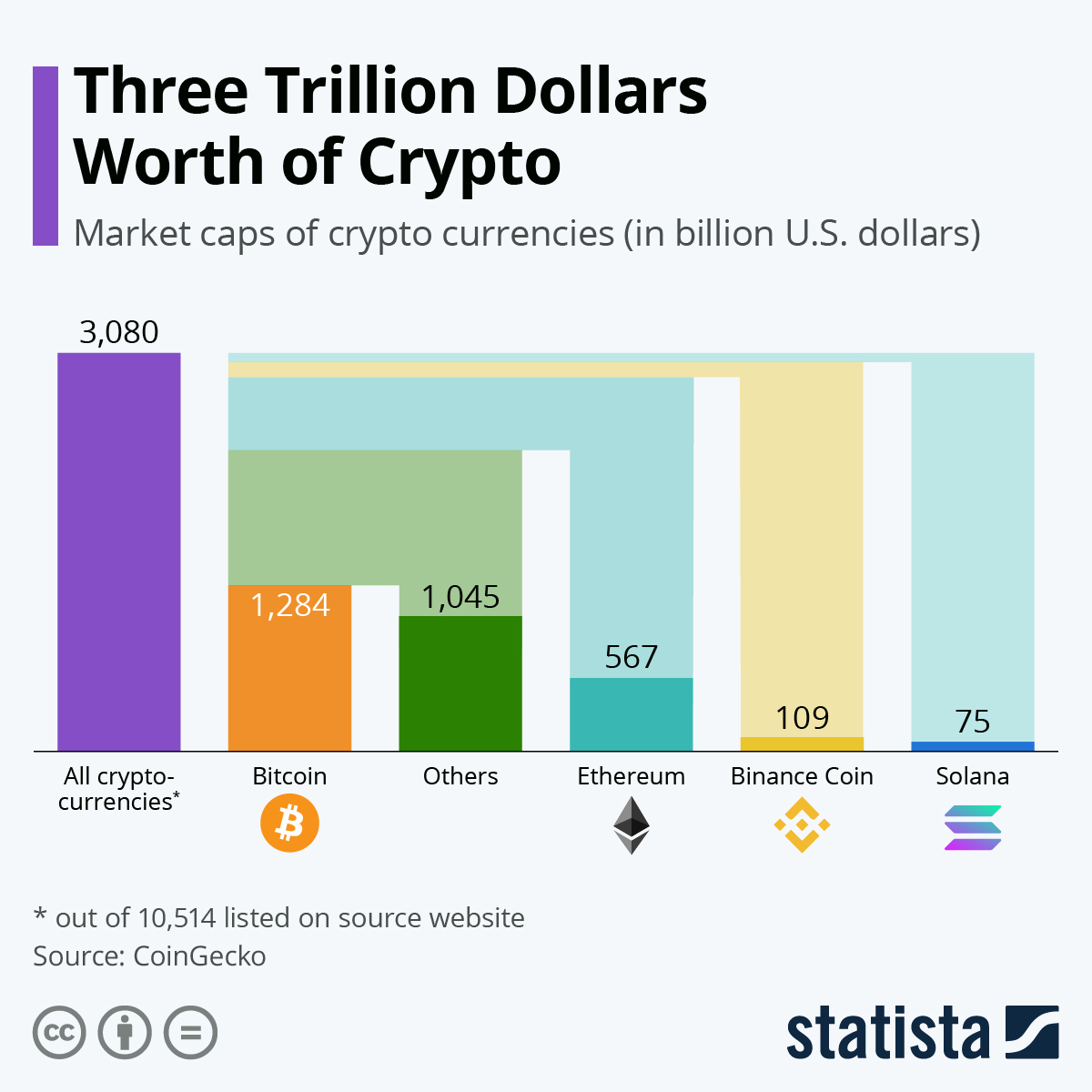
Cryptocurrency market capitalization (market cap) refers to the total value of a particular cryptocurrency that is currently in circulation. It is calculated by multiplying the current market price of a cryptocurrency by the total number of coins or tokens that have been issued. The total market capitalization of all cryptocurrencies for today is $3,483,735,942,412
Do all cryptocurrencies use blockchain
Many blockchains are entirely open source. This means that everyone can view its code. This gives auditors the ability to review cryptocurrencies like Bitcoin for security. However, it also means there is no real authority on who controls Bitcoin’s code or how it is edited. Because of this, anyone can suggest changes or upgrades to the system. If a majority of the network users agree that the new version of the code with the upgrade is sound and worthwhile, then Bitcoin can be updated.
Another significant implication of blockchains is that they require storage. This may not appear to be substantial because we already store lots of information and data. However, as time passes, the growing blockchain use will require more storage, especially on blockchains where nodes store the entire chain.
The other issue with many blockchains is that each block can only hold so much data. The block size debate has been and continues to be one of the most pressing issues for the scalability of blockchains in the future.
Generating these hashes until a specific value is found is the “proof-of-work” you hear so much about—it “proves” the miner did the work. The sheer amount of work it takes to validate the hash is why the Bitcoin network consumes so much computational power and energy.